
The traditional way we are taught to study for major certifications is completely broken.
It usually goes like this: Buy a 900-page textbook. Read it cover to cover while highlight half the pages. Watch 40 hours of video courses. Take notes. Then, during the final week before the exam, open a test bank to see if you actually retained anything.
The result? You realize you forgot everything from Chapters 1 through 5, your anxiety spikes, and you scramble to re-learn weeks of material.
There is a better, faster, and more efficient way to pass high-stakes exams like the CISSP, PMP, or Security+. It is called the Reverse Study Method, and it starts by taking a full-length practice exam on Day 1.
1. The Day 1 Diagnostic: Exposing Your Blind Spots Immediately
Taking a final practice test before you have even opened the textbook feels uncomfortable. You will guess often, and your score will likely be terrible.
Do it anyway.
When you take a practice exam on Day 1, you aren't testing your knowledge; you are mapping the terrain. You are gathering data. High-stakes certifications are broken down into specific operational domains. A diagnostic run tells you exactly where your natural baselines are and where your critical gaps lie.
Instead of blindly spending 10 hours studying a domain you already intuitively understand from your day job, you can instantly reallocate that time to the high-weight domains where you scored a zero.
2. Setting the Semantic Anchor: Priming Your Brain to Learn
Your brain is highly efficient at filtering out information it deems useless. When you read a dense technical chapter without context, your brain treats the data like noise and discards it.
By exposing yourself to exam questions on Day 1, you create semantic anchors.
When you inevitably get a question wrong about an encryption standard or a project management framework, your brain registers that failure as a problem to be solved. Three weeks later, when you are reading your textbook and encounter the answer to that specific problem, your brain flags it: "Aha! This is the exact piece of information we needed for that question." Suddenly, reading the textbook becomes an active treasure hunt rather than a passive, mind-numbing chore.
3. Working Backwards: From Question to Domain to Requirement
Once you have your Day 1 diagnostic data, your study workflow shifts into reverse gear:
- Analyze the Question: Review the questions you missed. Don’t just look at the correct answer—read the detailed explanations (like those found on Pocket Prep) to understand the underlying logic.
- Isolate the Domain: Identify which official exam blueprint domain the question belongs to.
- Target the Core Requirement: Open your study guide directly to that specific subsection. Study the concept until you understand why the wrong choices were traps.
This targeted loop ensures that every minute you spend studying is directly tied to an actionable exam requirement. You completely eliminate the fluff.
4. Layering on the Clock: Building Pacing From the Start
The biggest trap of the Reverse Study Method is spending too much time overanalyzing individual practice questions early on. If you spend five minutes staring at a question on Day 1 trying to guess it, you are building bad habits.
From the very first day, pair your reverse study strategy with strict timing constraints.
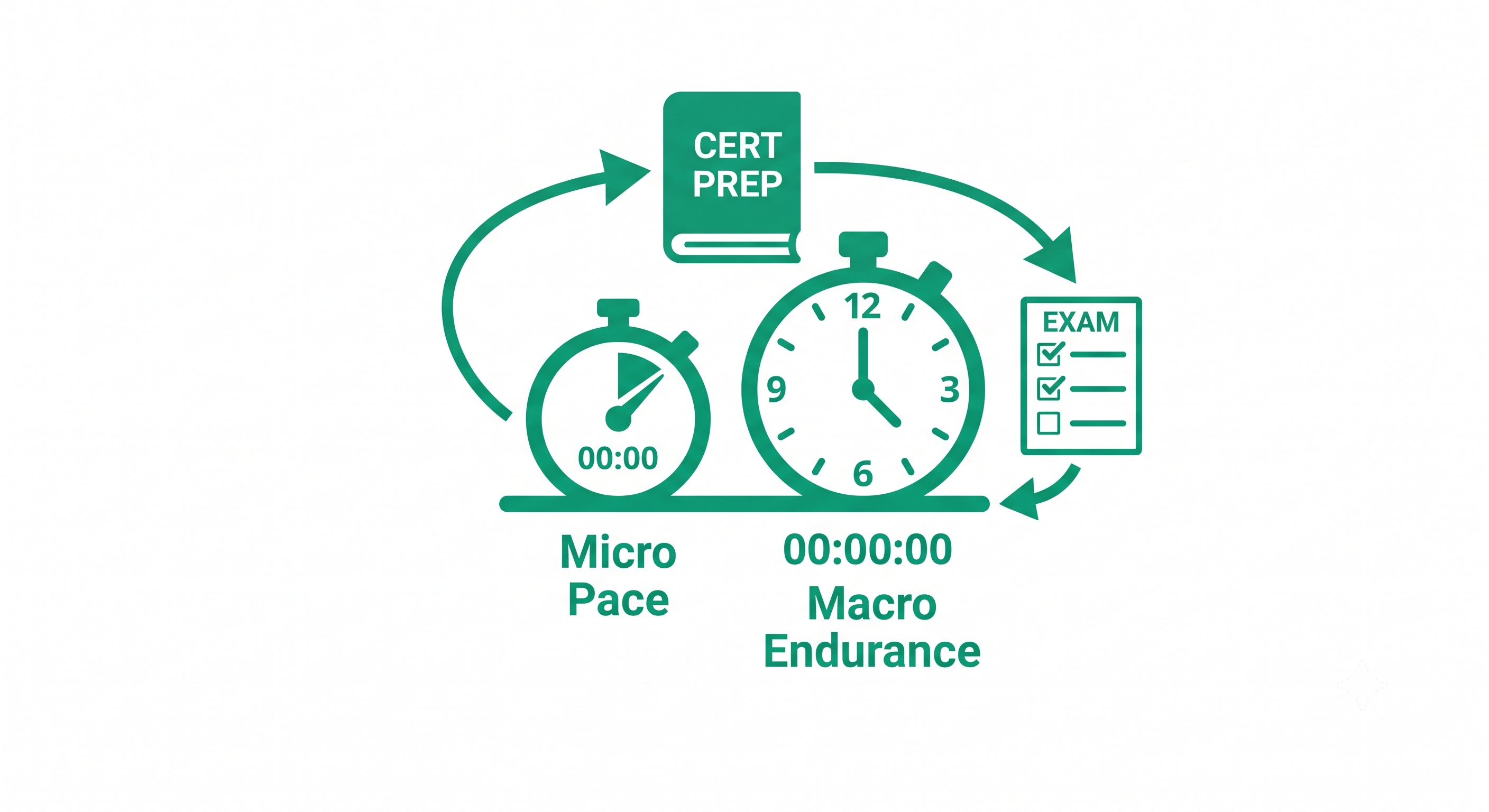
Use a dedicated utility like CertPacer.com to run your practice questions under realistic time limits (like 60 or 90 seconds per item). If the micro-timer hits zero and the smart-pause triggers, let it be a reality check. Read the explanation immediately, absorb the context, and move backwards into your study material.
By training backwards—starting with the test, mapping your gaps, and enforcing strict per-question pacing from Day 1—you build the exact cognitive muscle memory needed to walk into the testing center and pass on your first attempt.